The Histories brings together seventy works, including eight unprecedented paintings conceived especially for the occasion, following presentations at the Royal Academy of Arts in London and the Kunsthaus Zurich.
It traces eleven bodies of work from 1980 to the present day, but above all, it follows an idea pursued with remarkable consistency: Western art history has its voids, its hollows, its figures it never took the care to depict at human scale. Marshall does not merely append them to the margins. He reclaims the frames themselves.
Why Does Kerry James Marshall Look at Art History Differently?
There is a scene in the artist's biography that deserves recounting. In 1965, at the age of ten, Marshall visited a museum for the first time—the Los Angeles County Museum of Art—on a school field trip. Eleven years later, he returned several times to see David Driskell's exhibition, Two Centuries of Black American Art, once again at LACMA.
Between these two dates, his family settled in Watts, then in South Central Los Angeles, just a few streets from the Black Panther headquarters. He thus grew up between two worlds that did not speak to each other: that of the museum, where art rarely bore a Black face, and that of the street, where a history unfolded about which the museum remained silent.
Trained at the Otis College of Art and Design under Charles White, Marshall chose a path against the tide. In the 1970s, while conceptual artists abandoned painting and a faction of the Black Arts Movement rejected European traditions in favor of explicitly militant art, he resolved to master the Western canon thoroughly in order to upend it. It was not a matter of ignoring history painting, portraiture, or academicism. It was a matter of knowing them well enough to understand what they had excluded, and why.
From Invisibility to Presence
The exhibition naturally opens with this question of the invisible. Marshall’s paintings from the 1980s, such as Invisible Man, stage Black figures against dark backgrounds, almost dissolved by their own hue. Marshall worked with a palette of blacks mingled with other pigments—a technical choice that became a political gesture: making literally visible what the eye is unaccustomed to distinguishing.
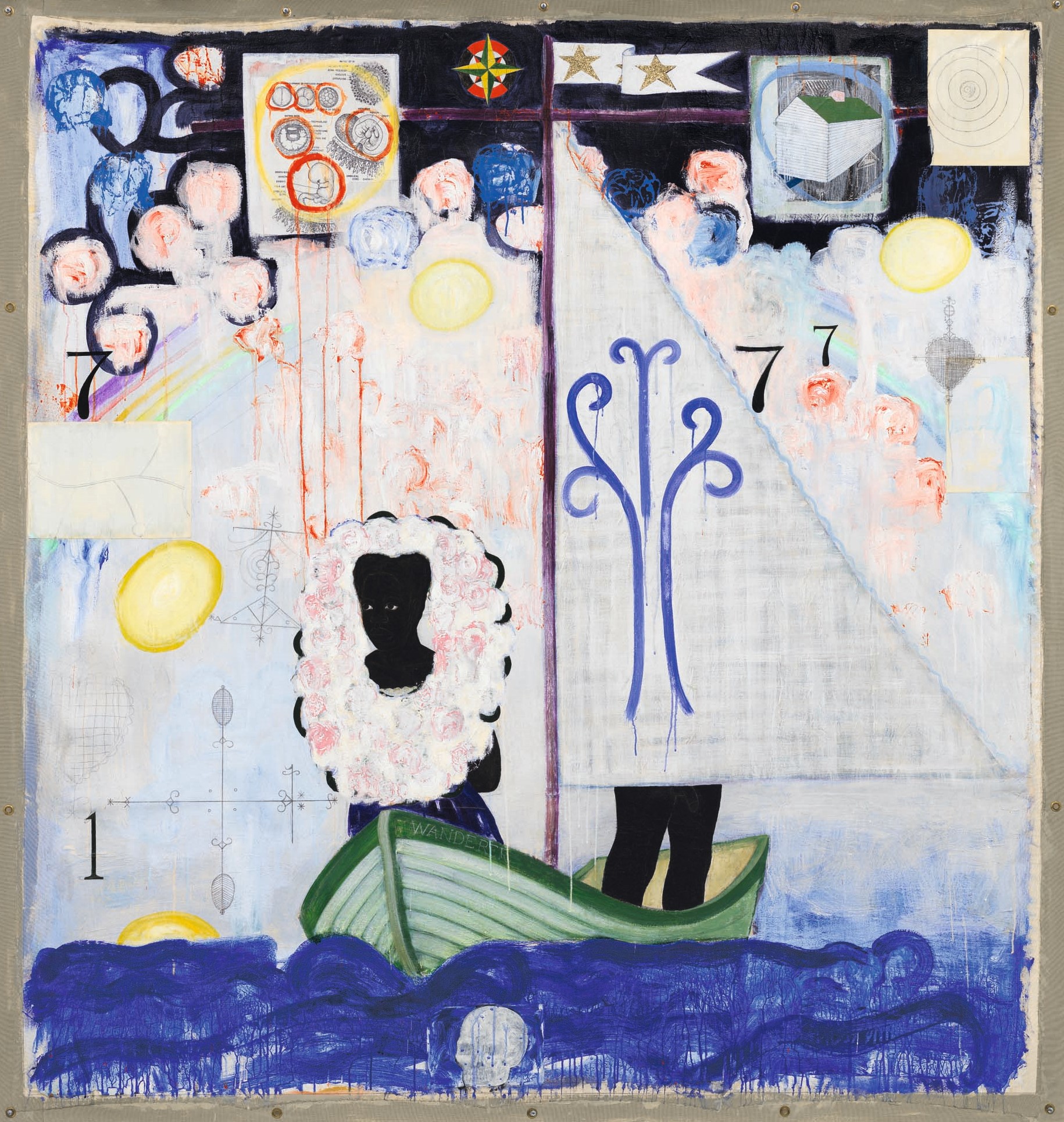
This tension between absence and presence finds another resonance with the Middle Passage—the forced transatlantic journey of captured and enslaved Africans. Rather than historical reenactment, Marshall chooses the fragment: Yoruba symbols, Vodou motifs, diagrams borrowed from syncretic religions born from the forced encounter between African beliefs and colonial Catholicism. He transforms the very incompleteness of this history—much of whose archive vanished alongside the lives it encompassed—into a method of composition.
When Black Figures Enter Grand Painting
This is perhaps Marshall’s most radical gesture: not merely representing Black figures, but introducing them into the very genres that art history had denied them. Portraiture, landscape, genre scenes, the painting of modern life—each of these territories is reclaimed, inhabited, and displaced.
One need only look at De Style (1993), the first of Marshall’s canvases to enter a museum collection: a barbershop, men waiting, conversing, having their hair styled. The composition draws from Mondrian’s Neoplasticism as much as from seventeenth-century Dutch group portraits. There is nothing anecdotal in this choice: a Black American barbershop rendered with the same formal gravity as a guild of merchants painted by Frans Hals is already a way of declaring: this, too, belongs to grand painting.
Five Works to Understand Kerry James Marshall
Gulf Stream and Wake (2003): The Sea, History, Accumulation
Presented together for the first time at the 2003 Venice Biennale, these two works converse with one another.
Gulf Stream revisits Winslow Homer’s famous 1899 painting, in which a Black sailor, adrift on a small craft, seems destined to drown amidst sharks. In Marshall’s rendition, the tone shifts: a group of friends enjoys an outing at sea, while a storm gathers on the horizon. The sculpture Wake depicts a black sailboat resting on a plinth evoking a dark sea—a work to which the artist adds a commemorative medallion with each new exhibition, inspired by nkisi nkondi , the power figures of the Kongo people bristling with nails. What Marshall displaces here is the European perspective on the Atlantic: a sea of leisure for some has long been, for others, a sea of vanishing.
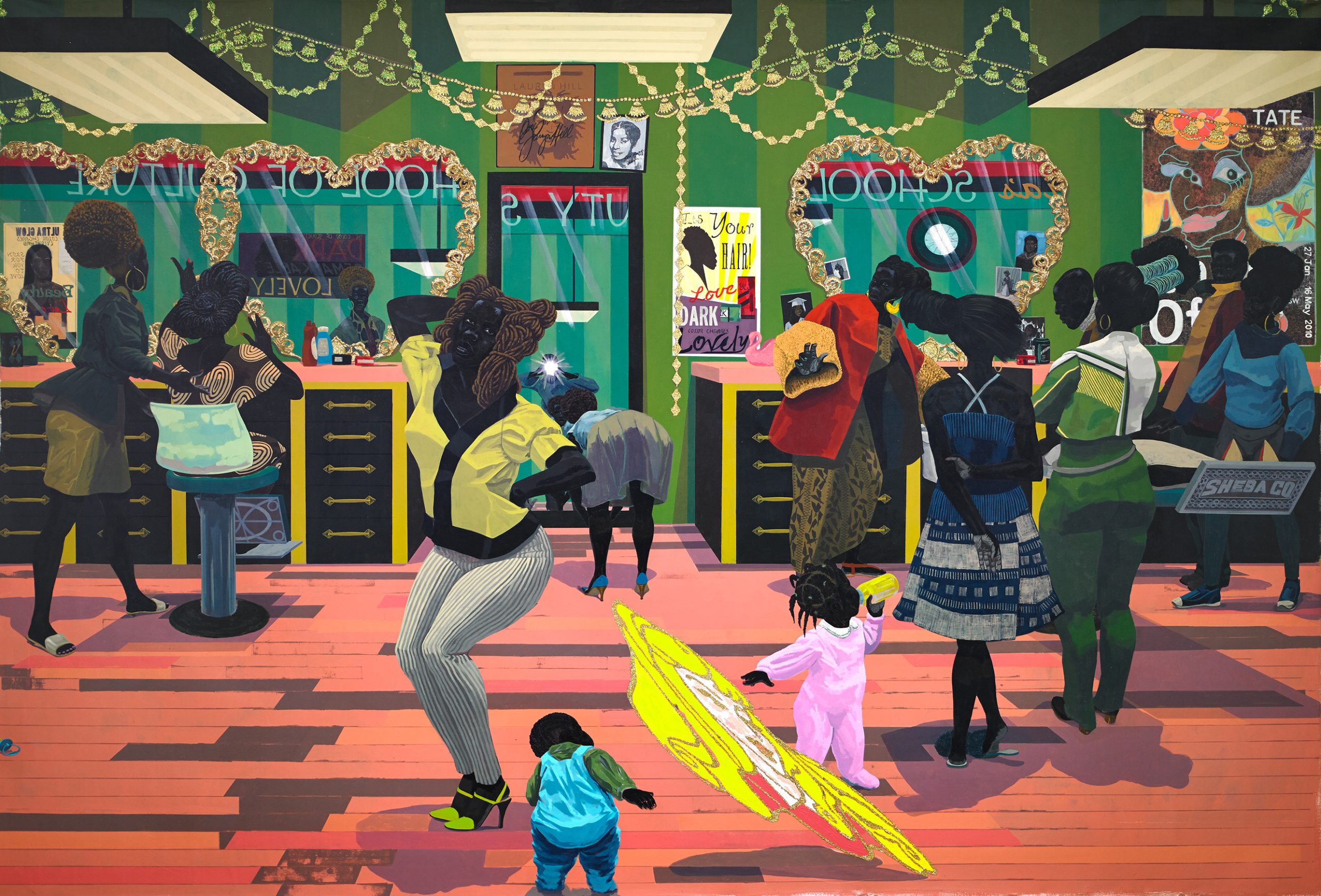
School of Beauty, School of Culture (2012): Holbein in a Hair Salon
A beauty salon, patrons in motion, light saturated with color. Marshall embeds a direct quotation: the anamorphic skull from The Ambassadors by Hans Holbein the Younger (1533), a painting that has questioned the limits of representation and illusion for five centuries. By introducing it into a setting seemingly distant from the Tudor court, Marshall is not offering an empty erudite nod: he reminds us that quotation, borrowing, and scholarly reference have always been tools of legitimation in painting—and that they can validate a scene of contemporary Black life just as readily as a royal portrait.
The Academy (2012): The Raised Fist in the Studio
Dans un cours de dessin d’après modèle vivant, un homme pose. Il lève le poing, geste immédiatement identifiable du salut Black Power. La scène se déroule dans le lieu même où se transmettent, depuis des siècles, les codes de la représentation académique l’atelier, l’école, le lieu où l’on apprend à regarder et à peindre le corps humain selon des canons précis. Marshall y interroge une question presque physique : que se passe-t-il quand le modèle, habituellement objet du regard, devient sujet d’un geste politique ? L’œuvre a depuis inspiré une performance immersive, signée Miles Greenberg, présentée dans le cadre de l’exposition.</p>
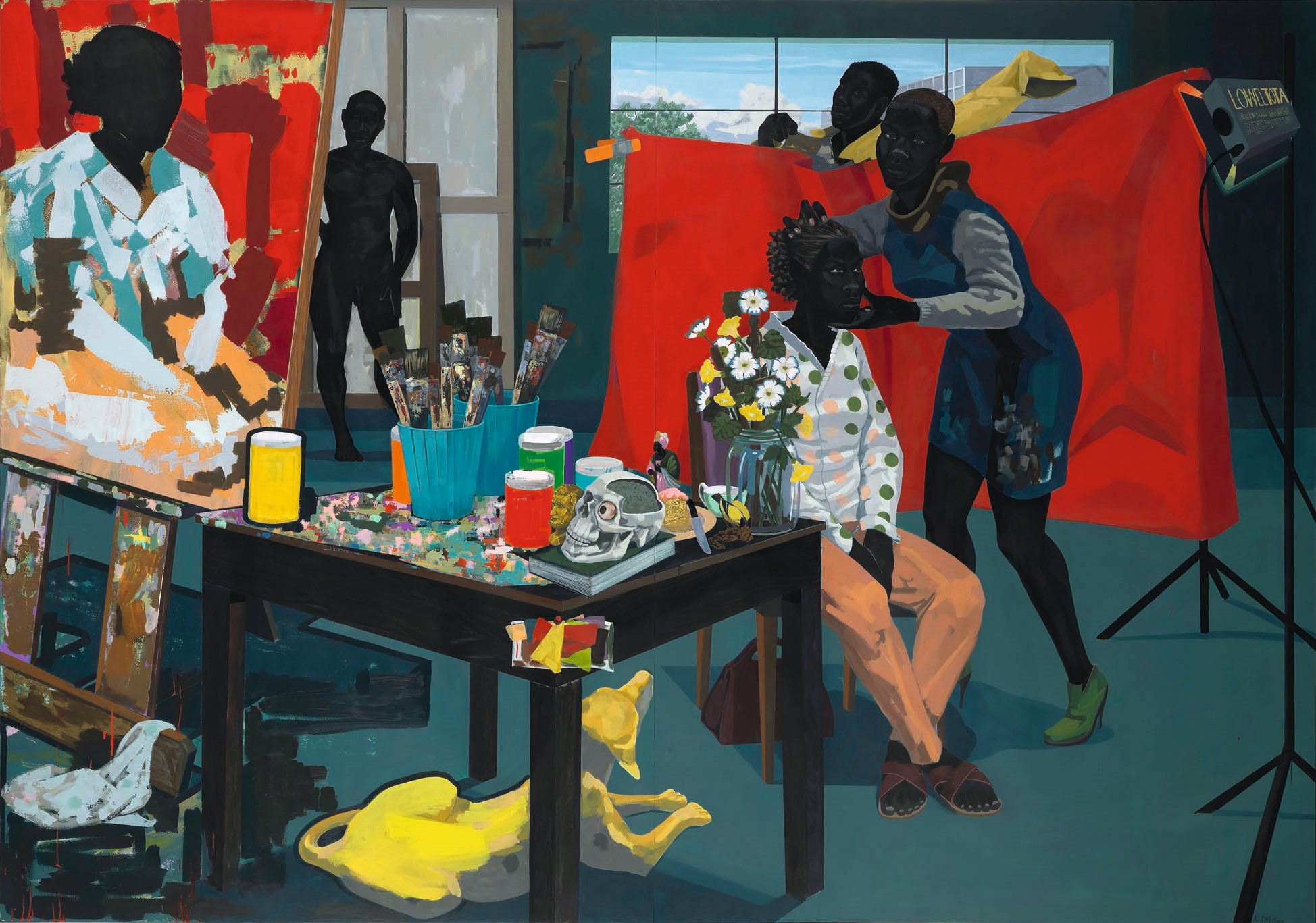
Untitled (Studio) (2014): A Woman Directing the Scene
This canvas summons two lineages of the painter’s studio: The Art of Painting by Vermeer (1666) and The Painter's Studio by Courbet (1854–1855).
In Marshall’s work, a Black woman pauses her painting to adjust the pose of a nude model standing in the background. She is not posing: she directs. This shift from the depicted object to the composing subject encapsulates what Marshall achieves, more broadly, within the history of painting: he does not seek to disavow the Western studio, but to recenter its protagonists.
Haul and Six for One (2023–2025): Africa Without Idealization
Among the eight unpublished works created for the exhibition, this series interrogates a lesser-known chapter of the slave trade: the role played by certain African merchants in selling captives to European slavers.
Haul depicts a pirogue laden with the payment received in exchange for human beings: cowrie shells, rum casks, muskets, alongside absurdly incongruous items like a blonde wig or an empty gilded frame. Six for One portrays a village celebration whose title refers to the cost—six individuals—of a carousel horse. Marshall explicitly draws upon models from the "grand tradition": the composition of Haul dialogues with La Grande Odalisque by Ingres, while Six for One echoes The Intervention of the Sabine Women by David. These paintings, the most exacting of his recent series, refuse any idyllic vision of a pristine African past prior to European arrival. Here lies, undoubtedly, the most uncomfortable gesture of the exhibition—and the most indispensable to its overarching vision.
Painting History Without Fabricating an Idealized Past
This point must be underscored: Marshall does not produce a restorative Black history in the naive sense of the term. His portraits of historical figures—Harriet Tubman, Scipio Moorhead, or the anonymous rebels he envisions in the absence of archives—do not aim to establish a flattering new mythology. His canvases dedicated to the marriages of Ruth Williams and Seretse Khama, or Colette Hubert and Léopold Sédar Senghor, selectively reinvent details of these very real unions to question the ways postcolonial history is recounted or romanticized.
In the same manner, a work such as Untitled (Policeman) (2015), painted at the dawn of the Black Lives Matter movement, delivers no singular moral: it places a Black police officer before his patrol car without offering the viewer a prefabricated lens. This refusal of simplicity, this taste for contradiction and ambiguity, distinguishes Marshall's oeuvre from strictly affirmative or commemorative art. He constructs multi-layered images that embrace more questions than they resolve—an aesthetic choice that invites the viewer into an act of deep contemplation.
The Histories: An Exhibition on the Memory of the Gaze
What strikes the visitor upon departing the exhibition is not merely the novelty of the figures depicted, but how they compel us to reconsider the paintings we thought we knew. Once one has witnessed the citation of Holbein within a barbershop, The Ambassadors is never seen in quite the same way again. Once one has seen Gulf Stream respond to Winslow Homer, the sea of classical marine paintings ceases to be neutral.
Perhaps here lies the most intimate dimension of Marshall's work for a reader of Mlle Heredith: not solely in the Black, African American, or historical subject, but in what it does to the act of seeing itself. It is not about adding images to those that already exist. It is about understanding that every image carries the imprint of what it chose to silence, and that this trace can be reactivated at any moment.
Marshall recounted boarding an airplane for the first time in his life in 1980, with the sole purpose of seeing Guernica in New York. The choice is telling: with this canvas, Picasso created the most fiercely debated history painting of the twentieth century. Forty-five years later, Marshall is celebrated as the heir to this genre once deemed the most noble of all. He has simply transformed its cast.
To look at a painting by Kerry James Marshall is never merely to behold a new image. It is learning to see anew those we thought we already knew.