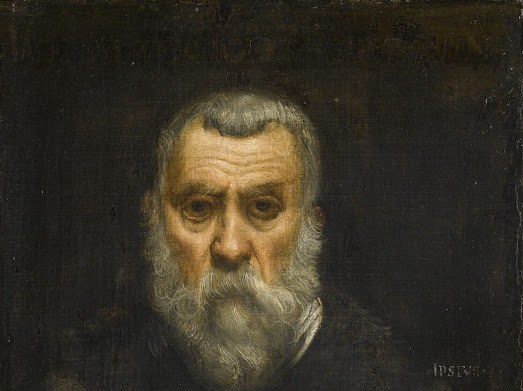
An old man with a hollow gaze has been staring out from the canvas for four centuries. His beard is white, his eyes shadowed, the black of his garment melting into the darkness of the background. Tintoretto painted this very face himself, around 1588, two years before his death. Édouard Manet replicated it line for line in 1854, in an act of such complete reverence that today, standing just a few feet away, one hesitates to say which of the two paintings is gazing at the other.
It is this conversation across the centuries—Venice speaking to Paris, the sixteenth century responding to the nineteenth—that the Musée Jacquemart-André brings to light starting September 11, 2026, in the first French retrospective ever devoted to Jacopo Robusti, known as Tintoretto.
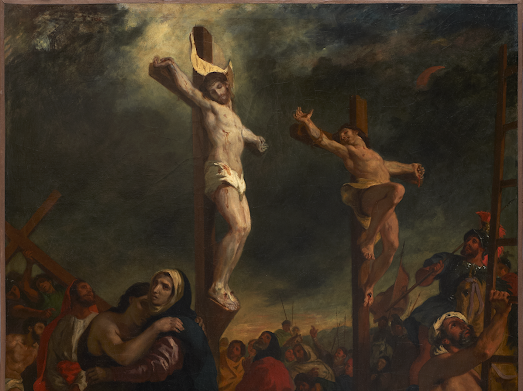
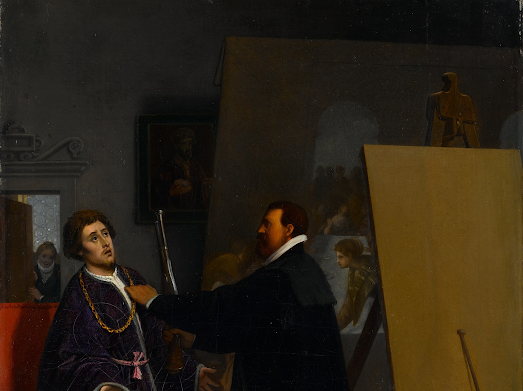
We know Tintoretto by name. We rarely know his oeuvre in its entirety—and this is precisely the void that the Musée Jacquemart-André seeks to fill. Bringing together some forty paintings and drawings from Venice, Vienna, Florence, Oxford, New York, or even a humble Parisian church, the exhibition does not merely showcase a great sixteenth-century master: it tells the story of how a man once dubbed by Vasari as “the most terrible brain that the art of painting may ever have produced” came, two and a half centuries later, to haunt the studios of Delacroix, Manet, and Cézanne.


Tintoretto's first great masterstroke, painted when he was not yet thirty years old. A saint bursts forth from a stormy sky to heal a crowd of the afflicted; in the foreground, a sick man reaches out toward the visitor, in a gesture that literally invites them to enter into the miracle.
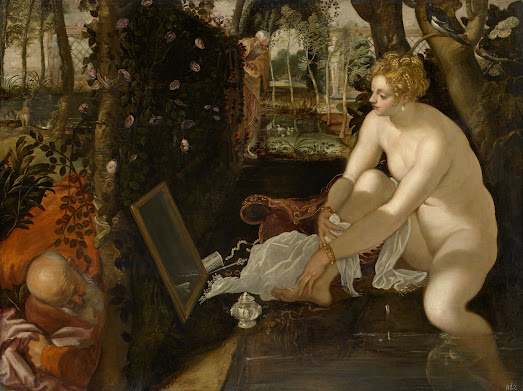
Tintoretto captures the moment just before the biblical drama unfolds, while two elders still spy on Susanna at her bath. Seated before a mirror, she becomes both subject and snare: the viewer, much like the elders, finds themselves an unwitting voyeur.
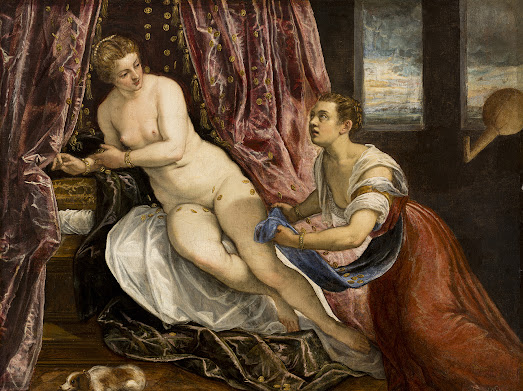
On loan from the Uffizi in Florence, this mythological scene plays out within an almost mundane domestic interior—a servant folds linens in the background, as though the tale of Jupiter’s metamorphosis were, to the household, merely an ordinary afternoon.
Long dismissed as a mere workshop copy in a Parisian church, this monumental canvas was rediscovered during a recent restoration to be largely an autograph work. It is currently on view at the Church of Saint-Eustache, just steps from the Louvre—a rare opportunity to encounter a Tintoretto outside museum walls.
The Self-Portrait (circa 1588) facing its copy by Manet (1854)—the most poignant dialogue in the exhibition. Manet went so far as to reproduce an inscription that was subsequently lost on the original during a 1940 restoration; his copy therefore remains the sole surviving trace of that very text.
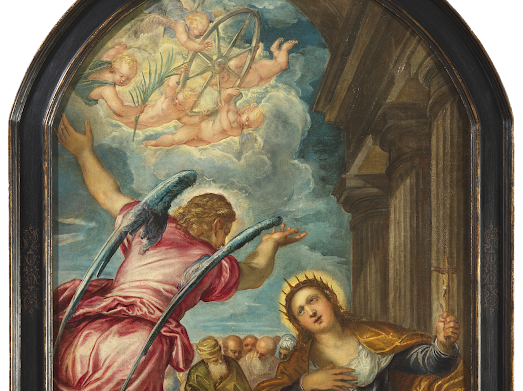
Saint Catherine of Alexandria and an Angel, painted by Tintoretto's workshop between 1557 and 1570, once belonged to David Bowie, who acquired it around 1983 and kept it until his death in 2016. Fascinated by the Venetian painter's flamboyant vision, he even named one of his own music publishing companies "Tintoretto Music." Today held in a private collection, the painting is on view in France exclusively for the duration of this exhibition.